AI and IT News Recap: August 31, 2026: ShinyHunters Vishes McKesson for 284 Million Health Records, ServiceNow Patches Three Perfect-10 Flaws, and Anthropic Quietly Trims Claude Code
By Noah Smith, Owner & Consultant, KeyChange Technologies · August 31, 2026
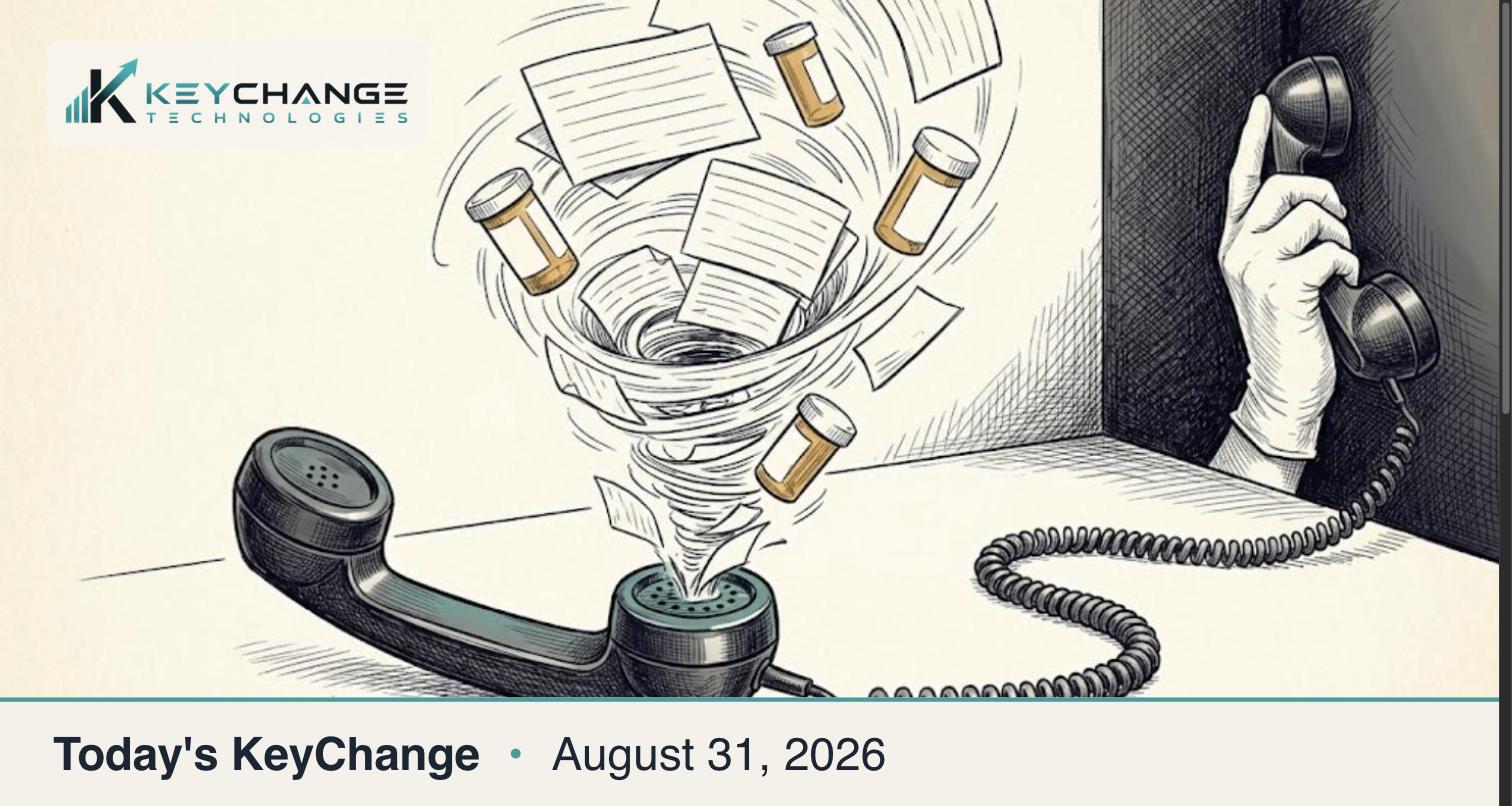
Your fast, no-spin read on the AI and IT news that actually matters to a business owner today. It was a quieter weekend, but a few stories carry real weight: a major healthcare distributor got socially engineered out of a massive trove of patient data, ServiceNow shipped fixes for three perfect-score flaws, and Anthropic dressed up a usage cut as an upgrade.
📌 The AI and IT news at a glance
- 🔝 McKesson disclosed a breach after the ShinyHunters group claimed it stole about 284 million patient-related records through phone-based social engineering.
- 🤖 Anthropic is "raising" Claude Code weekly limits by 25% from September 14, which actually works out to a 17% cut from what you have right now.
- 🤖 Anthropic warned some Claude users that infostealer malware on their PCs hijacked their active login sessions and burned their usage.
- 🛡️ ServiceNow patched three maximum-severity flaws in its AI Platform that unauthenticated attackers could exploit for code injection, SQL injection, and privilege escalation.
- 🛡️ Malicious Chrome and Edge extensions with a crypto-draining, data-stealing framework were caught after quietly turning on users, some with 70,000-plus installs.
- 🛡️ PaperCut shipped a second emergency patch for two actively exploited flaws that chain into pre-authentication remote code execution.
- 🛡️ Hasbro disclosed a breach exposing employee personal and financial data.
- 🧰 Brave 1.94 added built-in email aliases so you can hand out disposable addresses instead of your real inbox.
Missed Friday? Catch up with the August 28 recap.
🔝 Top story: A phone call cost McKesson a mountain of patient data
Healthcare and pharmaceutical distribution giant McKesson disclosed a cybersecurity incident this weekend after the extortion group ShinyHunters claimed responsibility for a large-scale data theft. McKesson says it discovered the incident on August 25 and disclosed it in a Form 8-K filing with the SEC, noting the investigation is still in its early stages and that it has not yet determined the incident to be material. The company also warned customers they may see intermittent service degradation tied to the attack.
The how matters more than the headline number. ShinyHunters told BleepingComputer it got in through vishing, or voice phishing, calling multiple McKesson employees and talking them out of their Okta single sign-on credentials. From there the attackers reached the company's Salesforce and Snowflake environments and, over four days between August 21 and 25, exfiltrated roughly 1TB of data before demanding a ransom of about $55.2 million. One important caveat on the scary figure: ShinyHunters clarified that the "284 million" is a raw count of data records, or lines, not 284 million unique patients. The group claims the data spans names, addresses, dates of birth, Social Security numbers, medical record and Medicaid numbers, medications, and diagnoses, though McKesson has not confirmed what was taken and BleepingComputer has not verified the claims. This is part of a wider ShinyHunters wave against healthcare, following recent incidents at Medtronic, DentaQuest, and iRhythm.
In short: McKesson disclosed a breach after ShinyHunters used phone-based social engineering to steal Okta logins and exfiltrate a large volume of patient-related data from its cloud systems.
What it means for your business: The entry point here was not a software exploit, it was a convincing phone call. Every company with a help desk and single sign-on is exposed to the exact same playbook, and no firewall stops it. If your team can reset a password or approve an MFA prompt based on a phone request, that process is now a primary attack surface. Verify identity out-of-band, be skeptical of urgency, and make sure your most sensitive cloud stores are not one stolen SSO login away from full export.
My take: The most sobering detail is how ordinary the attack was. No zero-day, no malware wizardry, just a phone, a script, and an employee trying to be helpful. Vishing works because it targets people, not systems, and people are the one thing you cannot patch overnight. Treat your help desk like the high-value target it is, and drill it the way you would drill a fire alarm. The 284-million number will grab attention, but the lesson is that a well-rehearsed phone call is now one of the most effective tools in an attacker's kit.
Source: McKesson discloses breach after ShinyHunters claims patient data theft, BleepingComputer
🤖 AI
Anthropic frames a Claude Code cut as a raise
Anthropic announced it is "permanently raising" standard weekly usage limits in Claude Code by 25% for Pro, Max, Team, and seat-based Enterprise plans starting September 14. That sounds like a win, but it is not. Claude Code currently runs on a temporary 50% boost that stays in place only through September 13. So if your baseline allowance was 100, you have 150 today, and on September 14 you drop to 125. That is 25% above the old baseline but about 17% below what you actually have right now. Anthropic deleted its original announcement thread and reposted a clarification that openly admits the reduction, adding that more usage changes are coming to give people "more visibility and control."
In short: Anthropic's headline 25% increase to Claude Code weekly limits is really a 17% reduction from the current temporary allowance, taking effect September 14.
What it means for your business: If your developers lean on Claude Code, plan for less weekly headroom after September 13, not more. Usage does not map to a fixed number of prompts, since it varies with model choice, context length, and tool use, so watch your team's real consumption over the next two weeks to see whether the new ceiling pinches. If it does, budget for a higher tier before the change lands rather than after.
My take: I do not mind a vendor adjusting limits. Frontier compute is expensive, and honest pricing is fair game. What grates is the framing. Calling a cut a "permanent raise" treats customers as if they cannot do arithmetic, and deleting the first post only made it worse. The lesson for the rest of us is simpler: when a provider quietly moves a number, read the fine print and measure your own usage, because the marketing line and the invoice do not always agree.
Source: Anthropic is cutting Claude Code's current weekly limits by 17%, BleepingComputer
Infostealers are now hijacking Claude sessions
Anthropic also began warning some Claude users that infostealer malware running on their own PCs had stolen their active Claude login sessions. With a live session token in hand, an attacker can slip into the account without a password or MFA prompt and quietly burn through the victim's usage. It is a small story in scale but a useful reminder that the weak link is often the endpoint, not the cloud service.
In short: Anthropic notified affected Claude users that infostealer malware on their computers lifted active login sessions, letting attackers use their accounts and consume their usage.
What it means for your business: A stolen session cookie bypasses the password and the second factor you worked so hard to set up, because the attacker inherits an already-authenticated session. Any SaaS tool your team logs into is exposed to this if a company laptop gets infected. Keep endpoint protection current, treat "why is my usage so high" as a possible security signal rather than a billing quirk, and sign out of sensitive sessions rather than leaving them open indefinitely.
My take: This is the unglamorous side of AI security. Everyone worries about prompt injection and rogue agents, but the boring old infostealer on an employee's machine is still doing the damage. Session hijacking is a reminder that MFA is not a force field. If the endpoint is compromised, the attacker walks in on the credentials you already validated. Endpoint hygiene is not exciting, but it is where a lot of these incidents actually start and stop.
Source: Anthropic warns infostealer malware is hijacking Claude sessions to drain usage, BleepingComputer
🛡️ IT and security
ServiceNow patches three perfect-score AI Platform flaws
ServiceNow released fixes for three maximum-severity vulnerabilities in its AI Platform, the enterprise workflow engine formerly known as the Now Platform that the company says powers more than 100,000 apps at 85% of the Fortune 500. The three flaws, tracked as CVE-2026-18885, CVE-2026-18886, and CVE-2026-74820, cover code injection leading to arbitrary code execution, a second code-injection path that enables privilege escalation, and a SQL injection issue that lets attackers read or change instance data. All three can be triggered by unauthenticated attackers in low-complexity attacks that require no user interaction. ServiceNow also patched a high-severity sandbox escape, CVE-2026-6876, in the same platform. The company says it is not aware of active exploitation yet, but ServiceNow flaws have a history of being weaponized quickly once details circulate.
In short: ServiceNow patched three maximum-severity, unauthenticated flaws in its widely used AI Platform, plus a high-severity sandbox escape, with no known exploitation so far.
What it means for your business: If you run ServiceNow, this is a stop-what-you-are-doing patch, especially for any self-hosted instances you manage yourself. Unauthenticated and no user interaction means an attacker needs nothing from your side to start, and "no known exploitation" tends to have a short shelf life once a perfect-10 bug is public. Confirm your instance is on a patched release and check with your managed provider if ServiceNow is hosted for you.
My take: Three perfect scores in one advisory is a rough day for any vendor, and the fact that this is the AI Platform sitting at the center of so many enterprises makes it worse. The saving grace is that these were caught and patched before attackers, as far as anyone knows, got moving. That window does not stay open long. Patch now and do not wait for the proof-of-concept to show up, because with bugs this clean it usually does.
Source: ServiceNow warns of three max severity security vulnerabilities, BleepingComputer
Malicious browser extensions caught draining wallets and data
Security firm Socket uncovered a campaign of malicious Chrome and Edge extensions carrying a modular malware framework built to steal cryptocurrency, credentials, and browsing data. The researchers counted 16 distinct modules and say the operation may have been running since early 2024. The nasty twist is how the extensions turned bad: five of them were legitimate tools bought from their original developers, then poisoned with malware pushed through an automatic update. One example, a right-click-and-copy utility, had around 70,000 Chrome users and 10,000 on Edge when it went malicious. Once active, the framework drains EVM, Solana, and Tron wallets by hijacking "Connect Wallet" buttons, swaps in fake seed-phrase phishing pages for Ledger and Trezor, steals sessions from major exchanges, and pushes ClickFix-style fake update prompts. Google pulled the extensions from the Chrome Web Store, though some lingered longer on Edge.
In short: Socket found 16 malicious Chrome and Edge extension modules, some hidden in previously legitimate tools bought and updated with malware, built to drain crypto wallets and steal browser data.
What it means for your business: A trusted extension can turn hostile overnight through an update you never see, which makes browser extensions a real supply-chain risk on every employee device. Anyone who had one installed should assume their saved credentials are compromised and reset them, and anyone holding crypto should move it. For the office, inventory what extensions your team runs, remove what you do not need, and consider an allowlist so a silent update cannot hand an attacker the browser.
My take: This is the browser version of a supply-chain attack, and it is quietly one of the most underrated risks going. You vet an extension once, trust it, and then a new owner ships an update that turns it into a wallet drainer. The lesson is that "I installed it years ago and it was fine" is not a security posture. Extensions run with real access to what you type and see, so treat them like the privileged software they are, and prune aggressively.
Source: Chrome Web Store extensions caught stealing crypto, browser data, BleepingComputer
PaperCut ships a second emergency patch for exploited flaws
PaperCut released a second emergency patch for two actively exploited vulnerabilities in its widely deployed NG and MF print management software, after researchers found several ways to bypass the first fix. The two flaws now carry identifiers: CVE-2026-81578, an authentication bypass rated 8.8, and CVE-2026-82078, a critical unsafe class-loading bug rated 9.4. Chained together, they let an unauthenticated attacker bypass login and run code on the server. Security firm Huntress says it observed exploitation in two customer environments and reproduced the full pre-authentication remote code execution chain, while watchTowr found multiple patch bypasses and an additional authentication bypass. PaperCut is urging every customer to install Emergency Patch Release 2 for versions 24, 25, and 26, even if they already applied the first patch, and to restrict access to the web interface to trusted IP addresses.
In short: PaperCut issued a second emergency patch after its first fix for two actively exploited, chainable print-server flaws was found to be bypassable.
What it means for your business: Print servers are easy to forget and often sit deep inside the network with broad access, which makes a pre-auth code execution bug on one genuinely dangerous. If you run PaperCut NG or MF, install Release 2 now even if you patched last week, since the earlier fix was incomplete. Lock the web management interface down to trusted addresses, and check your logs for the reconnaissance activity the researchers described.
My take: The story here is not one bad patch, it is the reminder that "we patched it" and "we are safe" are different sentences. Attackers and researchers both kept probing after the first fix and found the door still ajar. That is normal, not a scandal, but it means a single patch is the start of remediation, not the end. Verify the fix actually holds, watch for exploitation, and treat print infrastructure as the soft target it usually is.
Source: PaperCut releases second emergency patch for exploited flaws, BleepingComputer
Hasbro discloses a breach of employee data
Toy and game maker Hasbro disclosed that attackers accessed the personal and financial information of an undisclosed number of its employees. The company has not detailed how the breach happened or exactly how many people are affected, but any exposure of financial data raises the odds of targeted fraud and phishing against those staff.
In short: Hasbro confirmed a breach that exposed personal and financial information belonging to an undisclosed number of employees.
What it means for your business: Employee data is a breach liability in the same way customer data is, and payroll or financial details make affected staff prime targets for follow-on scams. If you hold financial information on your own team, that HR database deserves the same protection and monitoring as your customer systems, and a breach response plan that includes notifying and supporting employees.
My take: Customer breaches get the headlines, but employee data leaks quietly cause just as much harm, and the people affected did not choose to take on the risk, they just took a job. It is a reminder that your duty of care runs inward too. If someone's bank details or Social Security number sits in your systems, protecting it is not optional, whether they are a customer or on the payroll.
Source: Toy-making giant Hasbro discloses data breach affecting employees, BleepingComputer
🧰 New tooling for builders and business
Brave adds built-in email aliases
The latest release of the Brave browser, version 1.94, adds a feature called Email Aliases that lets you generate disposable email addresses on the fly when you sign up for a new service. Instead of handing over your real inbox, you create a unique alias that forwards to it, and you can shut off any alias that starts attracting spam or shows up in a breach. It is a small, practical privacy tool baked directly into the browser.
In short: Brave 1.94 introduced built-in email aliases, letting users create disposable forwarding addresses when signing up for services.
What it means for your business: Disposable aliases are an easy way to compartmentalize where your address goes and to spot which vendor leaked or sold it, since each service gets its own address. For a small team, using per-service aliases for signups and vendor accounts adds a layer of privacy and makes it obvious where spam or a breach originated, without any extra infrastructure to run.
My take: This is a genuinely useful feature, and it is nice to see privacy tooling become a default rather than an add-on you have to hunt for. Aliasing is one of those low-effort habits that pays off later, the first time a vendor gets breached and only the throwaway address they had is affected. Worth trying even if you are not a Brave user, since the same idea is available through other providers.
Source: Brave browser adds email aliases to help users evade tracking, BleepingComputer
That is the AI and IT news that matters for August 31, 2026. Have a question about how any of this hits your business? Reach out to the KeyChange team, and check back tomorrow for the next recap.